
Image: Bellendena
Written by James Wood, Seed Bank Manager, Royal Tasmanian Botanical Gardens, James.Wood@gardens.tas.gov.au
In the early years of the Tasmanian Seedbank I was visited by several local native plant nurseries. They’d come to see our new facility and the conversation naturally flowed to the challenge of germinating native seed. One story that stuck with me was an attempt to propagate Tasmania’s Mountain Rocket (Bellendena montana). The nurseryman had collected seeds one autumn, sown them, but nothing emerged in the spring. So, the following autumn they collected again, sowed again, winter passed, but still no seedlings. So once again, that autumn they collected another sample and sowed. The following spring they got seedlings! Not just in one pot, but in all three sowings – the 1st year, 2nd year and 3rd year all emerged together. Why?
I am the manager of the Tasmanian Seed Conservation Centre, a seed banking initiative started in 2005. Our program is focused on the protection of plant biodiversity through the long-term storage of seed. As a consequence of that I’m deeply involved in native seed germination, because to utilise those collections we need to turn those seeds into plants. But as many will know that is often easier said than done, due to seed dormancy.
Seed Dormancy
But what is seed dormancy? That is a huge question and not one I can cover in a short article, but I’m going to try and give a brief overview. However, it is one of those subjects that gets more blurry the more you scrutinize it. Additionally, when I talk about germination I’m talking about the transition from seed to seedling. Seedling establishment I consider a separate matter.
Seed dormancy is considered a block to germination. If a healthy seed is exposed to appropriate moisture, air, light, and temperature, germination should take place. If it doesn’t you have seed dormancy. And right here is where our problems begin. What do we mean by appropriate?
There are seeds that won’t germinate if you keep them too wet. There are seeds that will only germinate if you remove oxygen. There are seeds that will only germinate in the dark. And then there is temperature. Beyond a specific requirement for either hot, warm or cool temperatures, many seeds want a daily temperature fluctuation. A lot of others don’t seem to care, but there are also a few species where a fairly constant temperature over day and night is required.
If we sow our seeds and get one of these four factors wrong, the seeds won’t germinate but they aren’t dormant; we’re doing it wrong. So, if your nursery has an unsuitable climate, you sow in the wrong season, or your lab has limited incubators you can get stuck on this first step. Now let me be clear, outside of temperature requirements, issues with water, air and light are uncommon, but it’s worth noting that there are many “dormant seeds” that are easier to germinate than “non-dormant seeds”. Welcome to the world of seed germination!
Dormancy Classification
Seed dormancy can be organized into four broad categories.
- Non-dormant seeds,
- seeds with external dormancy,
- seeds with internal dormancy, and
- seeds with both internal and external dormancy.
External dormancy is the very familiar hard seededness, where we need to crack seed coats to let water to get into the seed. If you’ve worked with Acacia, peas or mallows you’ll be familiar with this. It’s generally straightforward to deal with, and as it is strongly taxonomically linked it’s very predictable.
Internal dormancies are sadly not so kind. This is where things get gnarly. Seed biologists break these down into three major types – morphological, physiological, and morphophysiological.
Morphological is a post dispersal development of the embryo. This can be trivial to quite substantial with delays varying from days to months. Once you’re into Physiological or Morphophysiological you’re generally looking at seeds that require a specific trigger or series of triggers to get them to germinate. Or at least consider germinating. And these triggers can be variable.
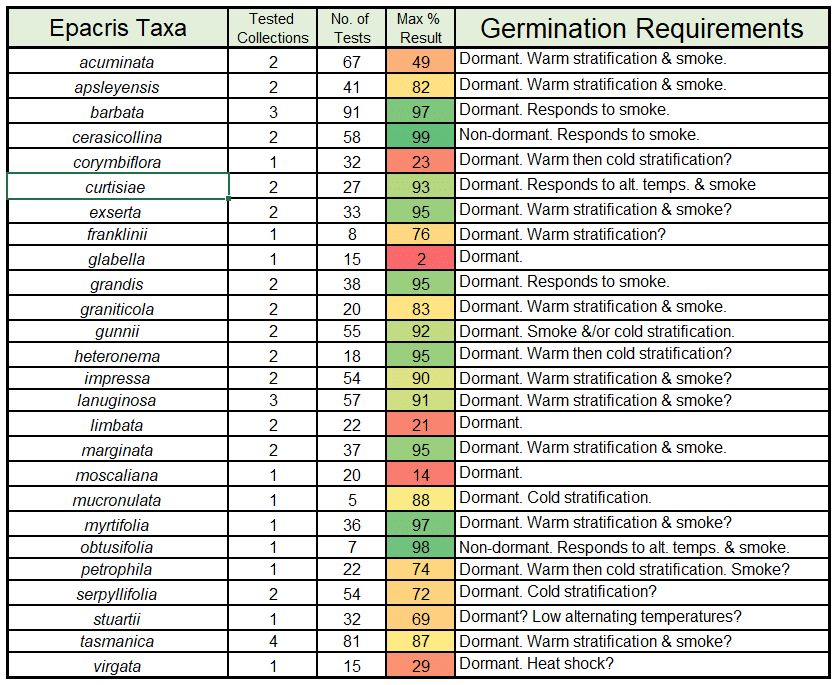
Table 1 – Germination behaviour of Tasmanian Epacris
Table 1 is a summary of testing data from the Tasmanian Seed Conservation Centre for germination of our native Epacris. We have quite a variety of species and overall, we’ve been fairly successful in germinating them, but you can see there are species that we still struggle with. If you look at the final column you can see quite a range of behaviours. Some species need smoke, some want warm stratification and smoke, others prefer cold stratification before warm incubation, others want a warm stratification before germinating at cool temperatures, and two species need only the right temperature to sprout. So, as you can see there’s quite a bit of variation just within this single genus. The nice thing about Epacris though is that the species are pretty consistent. Regardless of where or when we collect, a species responds in the same way. That is not true for a lot of other species. You can collect a species from different areas and its germination requirements can be different. You can collect from the same population in different years and its germination requirements can be different. You can collect seed from different parts of one plant in the same year and their germination requirements can be different. And it’s this aspect of seed behaviour that makes finding effective protocols for efficient germination so very difficult.
Finally, we have seeds with both internal and external dormancy, termed Combinational Dormancy. This isn’t all that common and generally isn’t too difficult either. In Tasmania it’s typically a chip and a chill and we’re good!
That is a very quick overview of germination and dormancy and hopefully elucidates why native seed propagation can be so challenging.
However, there are two other factors worth mentioning. One is seed quality. Dead or empty seed is never going to germinate. So, sowing viable seed is obvious. However, because of the diversity of species we deal with it isn’t always obvious what is actually viable until it starts rotting. When performing a cut-test to assess collection quality, features we would use to diagnose poor health in many species, can be perfectly healthy in another.
The second issue is seed handling. Bad handling can reduce viability, but even in good practice seed dormancies can shift, so if you’re lucky your collection could become less dormant, but in the worst-case scenario you’ve made your job a lot harder. So, when interpreting germination results you have to consider what happened from development, to harvesting, to sowing, then seedlings, or lack of seedlings. With germination it’s all about the journey.
Testing at the Tasmanian Seed Conservation Centre
I run a seed bank, and germination is major part of what I do. We collect seed in the field, we clean it up, get it stored, and then we look at germination. The germination test for the seed bank is crucial. It’s the best measure of viability, and we have to able to turn our seed back into plants.
Our testing programme began in 2006 with just two incubators and one volunteer, and that has slowly grown over time. Over the past twenty years we have set up over 10,000 germination tests on 945 different species. Analysis of our data shows that 69.9% of the species we’ve handled have achieved 70% or greater germination which looks pretty good. However, if we look at how many species we can consistently get to 70% germination, the species success drops to a less impressive 12.7%. Some of this is very likely due to dormancy issues, but there will undoubtably be other compounding factors here such as seed quantities, viability loss, incubator availability, and workload constraints. Our germination tests can run anywhere between 1 week and 5 years, but the bulk of our tests run between 9 to 28 weeks. Volunteers perform our germination tests and score tests weekly. So, the effort behind those 10,000 tests is immense, and is a testament to how amazing they are. Their testing work can be described as long periods of tedium, punctuated by brief moments of excitement, so their personal interest is absolutely essential in driving that relentless effort. But what have we learned from their seed-based battles?
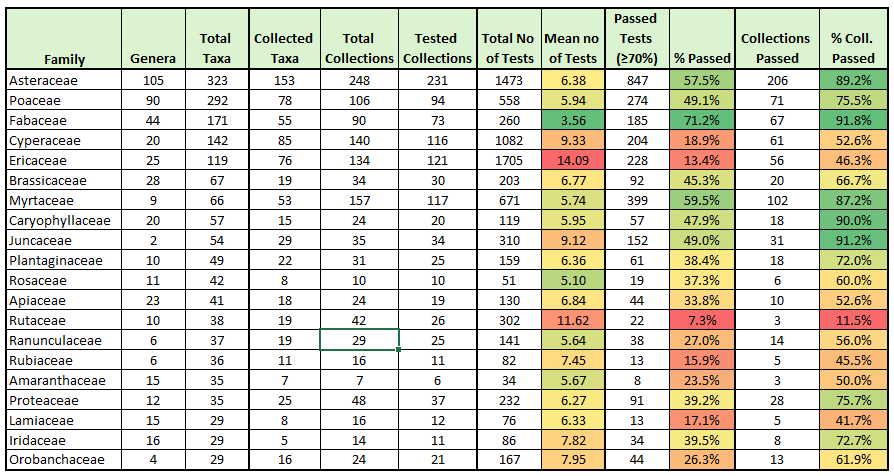
Table 2 – Germination Progress in Tasmania’s Twenty Largest Vascular Plant Families
Table 2 gives a summary of testing progress in Tasmania’s twenty largest vascular plant families, arranged by sizes with the daisies at the top with 323 taxa. You can see the number of collections we’ve tested, the number of tests that we’ve run, the number of tests achieving 70% or more germination, and most importantly the number of collections to achieve that threshold. Results here are a common experience – daisies, grasses, legumes, and Myrtaceae are pretty easy to germinate. We don’t have to run many tests to get a pass result. But you can see we have some problem families. In the number 4 and 5 slot we have Cyperaceae and Ericaceae. We’ve run a lot of tests on these, for little return but I don’t consider this wasted effort. Both of these families can dominate understory in Tasmania, and if we want to able to restore or translocate these communities we need these keystone species in the mix. We can’t ignore the hard stuff.
Sharing Information
So those efforts are great but I only I benefit if I’m not sharing this information, so back in 2008 we started posting our germination data online through the RTBG seed germination database. It’s sits on the Royal Tasmanian Botanical Gardens website. You can search for a Family or a Genus and all the records relevant to that search will be displayed on the webpage, but can also be download as a pdf. The database reflects the way I work. When I’ve have a new collection to test, I start by looking at what we’ve done so far to get a feel for what does and doesn’t work, then set up a few tests to probe that search space. If it’s something new or I’m hitting a brick wall, then I look further afield. One option is the Australian Virtual Seed Bank, a database holding information from across the Australian seed bank network. There’s also the Seed Information Database which houses germination data from Kew’s Millenium Seed Bank Project. There’s a lot of data here but you can only view germination information one species at a time which means getting an idea of what related species tend to require can be a slow process. However, that data is also available through Millennium Seed Bank Data Warehouse. You need to register to access, but it will give you more complete germination data.
One criticism for databases like these is that they’re only helpful to those with access to incubators. However, these techniques can be interpreted for nursery application as long as the identified temperature limits can be met in the nursery or field. Many nurseries also record and share data but my criticism of these datasets is they lack some of the fields useful to gage the successfulness of the technique, like germination percentage, whether it was fresh or stored seed, collection provenance, or conditions experienced in the trial. Which brings me back to the Bellendena.
The observations of nurseries and growing groups can be vital clues in resolving dormancy. The frustrating end of this story was that the grower couldn’t recall the year germination took place so I couldn’t chase down the meteorological data to see what had happened that year. They couldn’t recall if the third winter was significantly different either, so the germination event remains a mystery. We have tested three collections of Bellendena so far. Over the last 15 years we’ve run 35 tests, and the best we’ve achieved so far is 22% germination. My data suggests that the seeds have to go through a summer-winter-summer-winter to get germination. But the nursey observation suggests that’s not true.
To those not familiar with this field I hope I’ve persuaded you that the challenges of germinating native seed is very real. This is concerning as effective and efficient germination techniques are key for genetically diverse restoration and revegetation efforts. But my experience in the field and feedback I’m getting from community and commercial growers, is that collecting native seed is becoming more difficult. If this is indeed the trend then effective, efficient techniques become all the more critical. But resolving these challenges takes time, a lot of effort, and a lot of resources.
Although seed banks are heavily engaged in this work, the scale of our efforts I believe are still modest. We’re making these efforts publicly available, but it’s unclear as to how useful that information is to the larger conservation community. The Tassie database seldom receives feedback apart from when it goes offline. Which brings me to my final point. Online resources are great, but it’s become clear to me in the last few years that they are only as secure as the people or the funds that support them. As such I encourage anyone involved in propagation to check out these seed bank resources and please feedback if it’s valuable, and tell us what could be done better.
Links
RTBG Seed Germination Database https://gardens.tas.gov.au/conservation/seed-conservation/seed-germination-database
Australian Virtual Seed Bank https://seedbank.ala.org.au
Seed Information Database https://ser-sid.org
Millennium Seed Bank Partnernship Data Warehouse https://brahmsonline.kew.org/msbp/SeedData/DW


